The Rise of Social Commerce: Why Some Products Go Viral on TikTok
.png)
Social commerce, and particularly TikTok Shop, is probably one of our biggest interests in e-commerce right now because it feels like we're watching consumer buying behaviour shift in real time.
For years, the typical ecommerce journey looked something like this:
Search → Website → Purchase
Increasingly, that journey is becoming:
Content → Creator → Purchase
The growth of TikTok Shop is difficult to ignore. In the UK alone, there are now over 200,000 active businesses operating on the platform, with sales nearly doubling year-on-year. TikTok Shop has also become the UK's fourth-largest beauty retailer.
As more brands invest in social commerce, one question keeps coming up:
Why do some products explode while others barely gain traction?
The interesting thing we've noticed is that products don't go viral purely because they're good.
Looking at brands consistently performing well on TikTok Shop, there are a number of recurring patterns.
1. Successful Brands Focus on One Hero Product
One of the biggest mistakes brands make is trying to promote an entire catalogue.
The brands seeing the greatest success on TikTok Shop often focus their efforts on a single hero product rather than dozens of products simultaneously. This is particularly common in beauty, skincare and haircare categories.
Why?
Because simplicity sells.
Consumers scrolling TikTok don't want to evaluate twenty products. They want a clear problem and a clear solution.
Examples include:
- A viral mascara
- A specific skincare treatment
- A single hair styling product
- A bestselling beauty tool
The most successful brands create focus. Once a hero product gains momentum, other products in the range can benefit from the increased visibility.
2. Creator Volume Beats Creator Perfection
Many brands spend months trying to find the "perfect" creator.
The brands growing fastest often take a different approach.
They focus on volume.
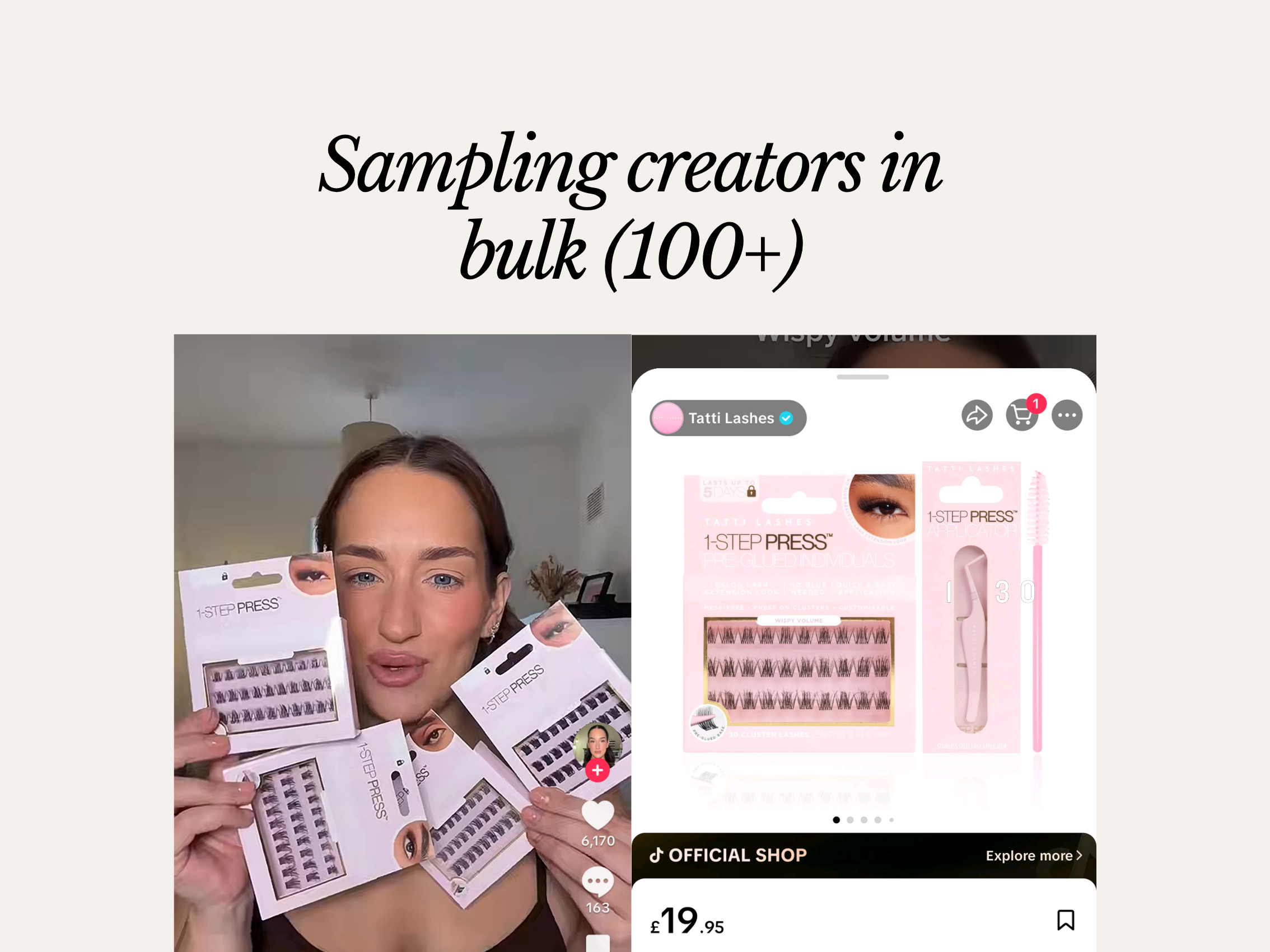
Rather than working with a handful of creators, successful TikTok Shop brands frequently sample products to dozens or even hundreds of creators. Some brands regularly send products to more than 100 creators at a time.
This approach creates multiple opportunities for content to perform.
Not every creator will generate sales.
Not every video will go viral.
But volume dramatically increases the likelihood that one piece of content breaks through.
TikTok rewards scale.
The more authentic content being created around a product, the more visibility that product receives.
3. Affiliate Incentives Drive Growth
One of TikTok Shop's most powerful features is its affiliate ecosystem.
Creators don't simply promote products because they like them.
They promote products because there is a commercial incentive to do so.
Brands that perform well on TikTok Shop typically have strong affiliate programmes in place, offering commission rates that encourage creators to actively sell products rather than simply mention them.
This creates alignment.
The brand wants sales.
The creator wants sales.
The platform wants sales.
Everyone benefits when content performs.
The key isn't necessarily finding one huge creator.
It's building relationships with a broad network of creators who can consistently generate content and sales over time.
.png)
4. Promotion Still Matters
A surprising number of viral products have one thing in common:
A promotion.
TikTok Shop users have become accustomed to discounts, vouchers, free delivery offers and limited-time deals. The platform itself frequently supports promotional activity through seasonal campaigns and discount initiatives.
Consumers scrolling TikTok are often making impulse purchases.
A compelling offer can be the final push needed to convert interest into a sale.
This doesn't mean products need to be heavily discounted forever.
However, strategic promotional activity can significantly increase product visibility and conversion rates.
5. Creator Content Outperforms Traditional Advertising
Perhaps the most important lesson from TikTok Shop is that polished brand content isn't always the best-performing content.
Consumers increasingly trust creators more than brands.
A creator demonstrating a product in their bedroom often feels more authentic than a professionally produced advertising campaign.
Successful brands understand this.
Rather than replacing creator content with advertising, they amplify it.
Many brands run TikTok Ads using creator-generated content because it combines authenticity with scale. Creator videos frequently outperform polished ads when acquiring new customers and building trust.
The best-performing content often feels:
- Honest
- Relatable
- Unscripted
- Educational
- Entertaining
This is where social commerce differs from traditional e-commerce.
Customers aren't simply buying products.
They're buying recommendations.
Products Don't Go Viral Because They're Good
This is perhaps the biggest misconception surrounding TikTok Shop.
Good products help.
Great products help even more.
But products rarely go viral because of product quality alone.
More often, brands create systems that maximise visibility.
Those systems include:
- Hero products
- Large creator networks
- Affiliate programmes
- Promotional activity
- Creator-led advertising
The result is a self-reinforcing cycle of content, engagement and sales.
The Bigger Question
What fascinates me most about TikTok Shop isn't necessarily the platform itself.
It's what it tells us about changing consumer behaviour.
For years, brands focused on getting customers to search for products.
Today, customers increasingly discover products through content.
Social commerce is blurring the lines between entertainment, discovery and purchasing.
The question isn't whether TikTok Shop is growing.
The question is whether this shift represents the future of e-commerce.
And if it does, how should brands adapt?
Because increasingly, it feels like consumers aren't searching for products.
They're discovering them.

Olivia Robinson
After arriving at a fork in the road in my career I decided to take the plunge and wander purposefully, with determination, into the maelstrom of consultancy in online sales. It's been the most exciting decision I've ever made and I've been able to work with some of the most interesting brands the UK has to offer. I specialise in the intersection of ecommerce and marketing, the part of the Venn diagram that eCommerce & Marketing people don't like to occupy because it takes a lot of plate spinning - this is where I thrive.
We will happily conduct a free, no-obligation audit on your digital channels, with several key takeaways you can action yourself or request for us to assist you with. It's completey free for now but it is a limited time offer.
Explore more blogs