Stop Using Discounts to Fix Your Average Order Value
Beauty brands often try to increase average order value by putting another offer on the site, usually a percentage discount above a certain spend, a multibuy or a free gift that is extended as soon as the original deadline passes. It will often lift the reported basket value, but that does not automatically mean it has improved the order because the extra revenue may have come with a larger discount, a free product, more fulfilment cost and less contribution margin.
The longer-term problem is that customers become used to there always being a reason not to pay full price. Email performance becomes increasingly dependent on promotions, quieter trading weeks are fixed with another code and the business has to offer more to get the same response it used to get from less.
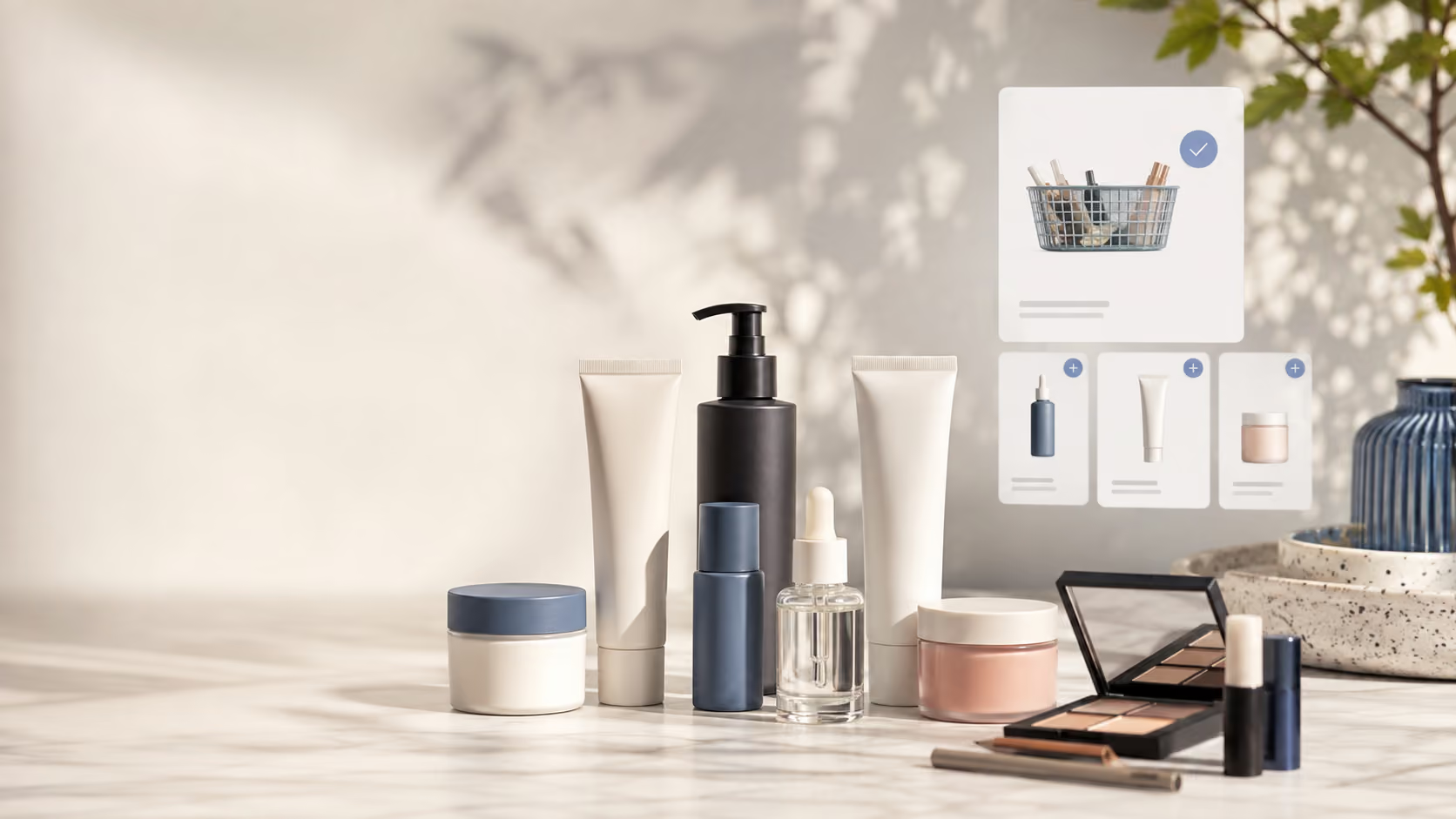
Beauty brands should not need to rely on this as heavily as they do because the products already sit naturally within routines. A brow pencil can lead into a brow setter, a styling tool should be supported by heat protection and a cleanser can be followed by a treatment and moisturiser, so the opportunity to build the basket already exists without inventing a random reason for the customer to spend more.
The issue is normally how that relationship is presented. Most bundles are built around what the business wants to sell, often because there is too much stock in one product or because grouping two SKUs together was easy to set up, but Product A plus Product B is not a proposition. A beginner brow routine, a damaged-hair recovery set or a five-minute makeup kit gives the customer a reason to understand why those products belong together and what buying them will help them achieve.
Build around the result, not the stock
I would start with the customer goal and work backwards, choosing the smallest number of products needed to deliver a complete and understandable result. The page should explain who the routine is for, what each product does, the order to use them and whether there are any choices the customer needs to make around shade, finish, scent or hair type.
Where fixed bundles become restrictive, a build-your-own option can work better because it gives the customer control without forcing them to accept a shade or product they do not want. It can also remove a common operational problem where every combination needs its own SKU, although the stock and fulfilment setup still needs to be thought through properly before launch.
Cross-sells should follow the same logic. Showing the same three bestsellers beside every product is not personalisation and it is rarely useful merchandising, particularly when the recommendation has no connection to the product being viewed. If someone is buying a brow pencil, show the setter or tool that improves the application. If they are buying a shampoo for damaged hair, show the matching treatment and explain why it is the next step, rather than dropping a generic carousel onto the page and hoping the customer works it out.
Thresholds can still have a role, including free delivery, samples, gifts or extra loyalty points, but the value needs to come from the actual order and margin data. I would look at the current AOV distribution, identify how many customers are already close to the proposed threshold and model the cost before choosing a number, because setting it at £50 simply because it looks tidy can either give away value to customers who would have spent that amount anyway or put the target too far away to change behaviour.
A higher AOV can still be a worse order
Average order value should never be reviewed on its own. I would put it alongside units per order, product attachment rate, contribution margin per order, discount and gift cost, return rate and repeat purchase, because the purpose is not to create the largest possible checkout total at any cost, it is to build a healthier and more profitable basket.
Free gifts need to be included properly as well. The product has a cost even if it is old stock, and there is also the extra picking, packing and customer service that comes with it, particularly when the gift is unavailable, substituted or missing from the parcel. If the campaign reports only the AOV increase and ignores all of that, it is not showing whether the mechanic worked commercially.
I would test one routine or bundle at a time, place it where it makes sense across the product page, collection and basket, then compare how customers respond to convenience, education, choice and a small saving. Some customers will value having the complete routine assembled for them, while others need help understanding why the second product matters, and that insight is much more useful than assuming another 15 percent code is the only way to move the basket.
The aim is not to make customers spend more for the sake of a metric. It is to help them buy a more complete solution while protecting margin, and if the basket only grows when a discount does all of the work, the product relationship is not doing enough.

Olivia Robinson
After arriving at a fork in the road in my career I decided to take the plunge and wander purposefully, with determination, into the maelstrom of consultancy in online sales. It's been the most exciting decision I've ever made and I've been able to work with some of the most interesting brands the UK has to offer. I specialise in the intersection of ecommerce and marketing, the part of the Venn diagram that eCommerce & Marketing people don't like to occupy because it takes a lot of plate spinning - this is where I thrive.
We will happily conduct a free, no-obligation audit on your digital channels, with several key takeaways you can action yourself or request for us to assist you with. It's completey free for now but it is a limited time offer.
Explore more blogs